Global expansion is no longer a luxury for eCommerce brands; it is a strategic necessity. However, moving beyond domestic borders requires more than just translating a website. It demands a robust technical architecture capable of handling diverse currencies, tax jurisdictions, and localized customer behaviors. Adobe Commerce (formerly Magento) is widely recognized as the premier platform for this task due to its native multi-site architecture. This article provides a factual, platform-first analysis of how to leverage Magento’s core capabilities to build a sustainable international presence.
Before implementing technical changes, a business must decide on the architectural framework that best suits its operational capacity and market goals. Magento offers three primary structures for internationalization, each serving a different level of market maturity.
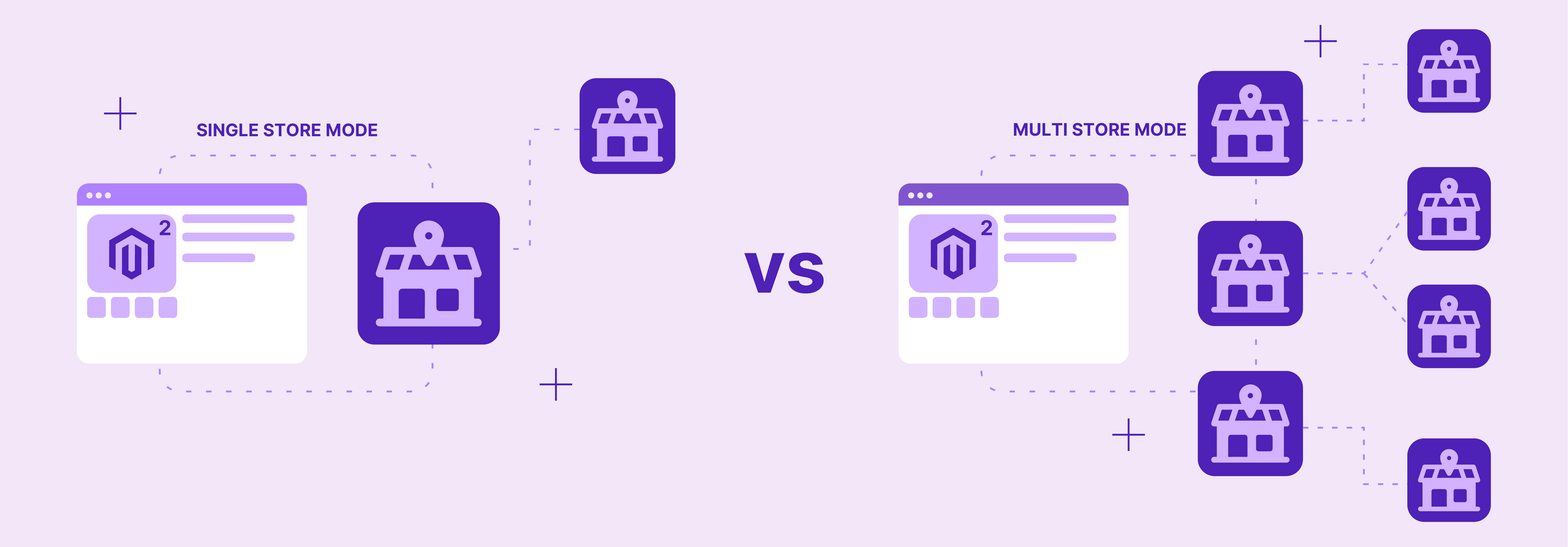
The single global store model involves one Magento instance with a shared catalog and global pricing. This is the most streamlined approach, where a brand uses a single storefront to serve multiple countries. While this minimizes administrative overhead, it limits the ability to localize content deeply. This model is most suitable for brands in the "discovery" phase, testing international demand before committing to heavy infrastructure.
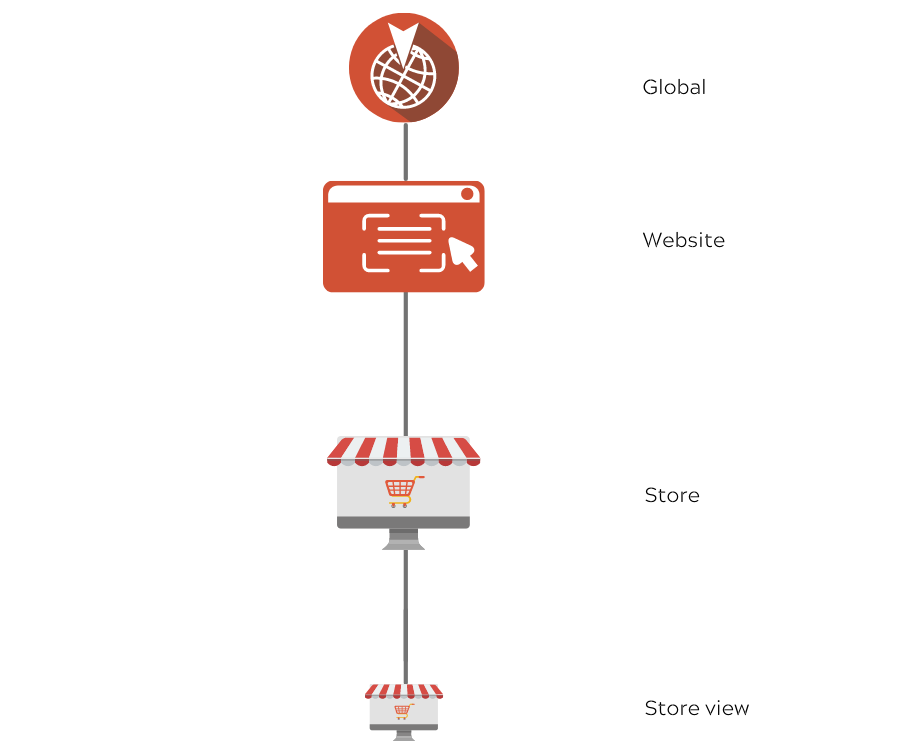
The store view level is the most common method for handling language variations within the same market or across similar markets. Under one Magento backend and one website, a merchant can create multiple store views. This allows for localized content, such as translated product descriptions and CMS pages, while sharing the same product prices and tax structures. It is ideal for a brand expanding into a multilingual region, such as Switzerland (German, French, Italian), where the legal and fiscal rules remain consistent across the country.
The multi-website model is the most robust expansion strategy. It allows for completely separate websites under a single Magento installation. Unlike store views, different websites can have unique pricing strategies, different base currencies, separate customer databases, and distinct tax rules. This is the recommended approach for entering markets with vastly different economic profiles or legal requirements, such as moving from the US market into the EU or Asia.
Localization is the process of adapting a product or service to a specific local market. In Magento, this extends beyond literal translation to include the entire user experience (UX).
Successful localization involves more than just product data. Magento’s architecture allows for "scope-based" configuration. You should use store views to manage language variations, ensuring that not only the product descriptions but also transactional emails, checkout messages, and CMS pages are localized. It is a factual reality in eCommerce that conversion rates drop significantly when a customer encounters non-translated text during the checkout process. Therefore, manual, high-quality translation for conversion-critical pages is superior to automated machine translation.
User experience must be tailored to local shopping behaviors. This includes:
Transparent pricing is a cornerstone of international trust. Customers are far more likely to abandon a cart if they are forced to pay in a foreign currency with unknown conversion fees.
Magento supports multi-currency natively. You can define a "base currency" for the website and then allow multiple "display currencies." Magento can integrate with services like Fixer.io or Yahoo Finance to update exchange rates automatically. However, for a professional global store, relying on fluctuating rates can lead to "unclean" pricing (e.g., $19.93 instead of $19.99).
For better margin control, Magento’s website-level pricing allows you to set specific, fixed prices for each market. This enables a brand to account for higher shipping costs or different competitive landscapes in specific regions without affecting the price in the home market. Using catalog price rules, you can also run regional promotions, such as a "Lunar New Year" sale in Asia that does not appear to European customers.
Tax compliance is perhaps the most technically demanding aspect of global expansion. Failure to comply with local tax laws like VAT in the EU or GST in Australia can lead to severe legal consequences.
Magento’s tax engine is highly granular. It allows for the creation of "tax zones" and "tax rates." You can define different tax classes for products (e.g., standard vs. reduced rate for essentials) and customer groups (e.g., B2B vs. B2C).
In many jurisdictions, such as the UK and EU, it is legally required to display prices including tax. In the US, prices are typically shown excluding tax. Magento allows you to toggle this setting at the website level, ensuring that the storefront remains compliant with local consumer protection laws. Furthermore, the platform can handle "cross-border trade" settings, which keep the price consistent for the customer even if the tax rate changes based on their location, with the merchant absorbing the tax difference to maintain price parity.
A one-size-fits-all approach to payments will fail in a global context. While credit cards are dominant in the US, other regions prefer alternative payment methods (APMs).
In Germany, SEPA and Sofort are preferred; in the Netherlands, iDEAL is mandatory for success; in many parts of Asia, digital wallets like AliPay and WeChat Pay are the standard. Magento allows you to enable or disable specific payment methods based on the "website" or "store view" scope.
By using country-based restrictions, you can ensure that a customer in Japan does not see US-only payment options. This reduces clutter and increases the sense of local presence. Additionally, Magento’s integration with global gateways like Adyen, Stripe, or Braintree allows for a unified backend to manage dozens of local payment types, simplifying financial reconciliation for the merchant.
Logistics is often where global expansion hits a physical ceiling. Magento’s Multi-Source Inventory (MSI) is the primary tool for managing this complexity.
MSI allows a merchant to link multiple physical warehouses (sources) to their digital storefronts (stocks). When an international order is placed, Magento can automatically route the fulfillment request to the warehouse closest to the customer. This reduces shipping times, lowers costs, and minimizes the carbon footprint of the delivery.
Shipping expectations vary by market. Some regions expect free shipping as a standard, while others are accustomed to high "last-mile" delivery costs. Magento enables the configuration of shipping methods per country, allowing you to offer "Click and Collect" in urban European markets while relying on standard carrier integrations (DHL, FedEx, UPS) for others.
International SEO ensures that the right version of your site appears to the right user in search results.
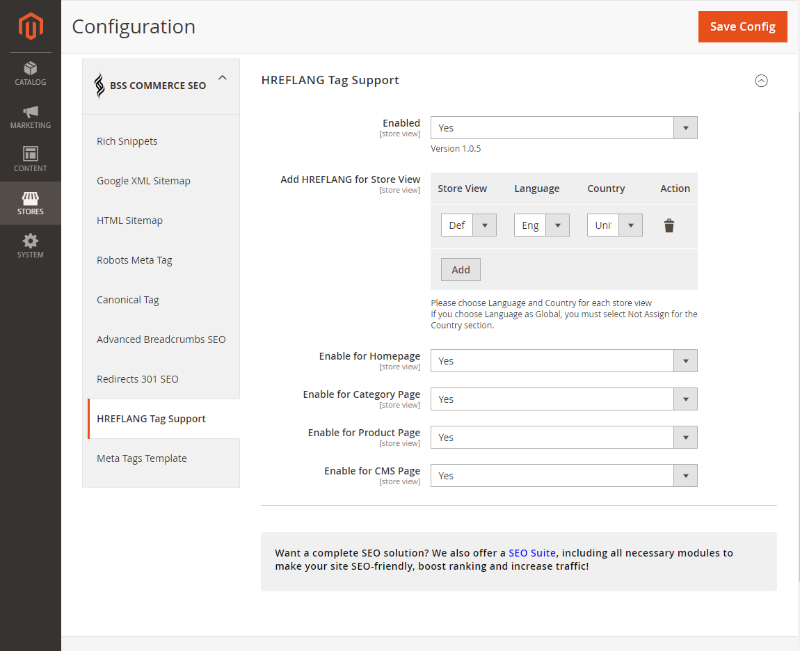
The most critical technical SEO element for global stores is the rel="alternate" hreflang="x" tag. This tells search engines which language/country a specific URL is intended for. Magento generates these tags based on the store view architecture, preventing search engines from seeing localized versions of the same product as "duplicate content."
Merchants must choose between subdirectories (https://www.google.com/search?q=example.com/uk/), subdomains (https://www.google.com/search?q=uk.example.com), or country-code top-level domains (example.co.uk). Magento supports all three configurations. Generally, subdirectories are easier to maintain from an SEO authority perspective, while ccTLDs provide the highest level of local trust.
Don’t let technical errors hurt your rankings. Before you launch your next store view, review these Common international SEO mistakes in Magento to ensure your global expansion is a success.
Distance creates latency. A Magento store hosted in Virginia will naturally perform slower for a user in Sydney unless optimized correctly.
A CDN like Cloudflare or Fastly is essential. These services cache static assets (images, CSS, JS) on servers located near the user. For Magento Commerce (Cloud), Fastly is integrated by default, providing image optimization and WAF (Web Application Firewall) security at the edge.
Magento’s Full Page Cache (FPC) should be configured to vary by store view. This ensures that a cached version of a page in "French" is not accidentally served to a user on the "English" store view. Furthermore, using a distributed database or advanced caching layers can help maintain a "Time to First Byte" (TTFB) of under 200ms globally.
As you add markets, the volume of data can become overwhelming. Centralized management is the only way to maintain a clear view of performance.
Magento’s admin panel allows for the filtering of reports by website or store view. This enables a merchant to see that while their "Global" AOV (Average Order Value) is healthy, their "Italy" store view has a high cart abandonment rate, perhaps indicating a localized issue with a payment gateway or shipping cost.
One of the primary benefits of Magento is that all international websites share the same core code, security patches, and admin users. This allows a central eCommerce team to manage a global empire without needing to log into ten different platforms. Customer Service teams can see all orders in one place, while still being able to identify which specific regional store the customer purchased from.
The technical capability of Magento to launch 50 stores at once does not mean a business should do so. A phased approach is significantly more successful.
Start by enabling international shipping on your primary store. Use Magento’s native functionality to accept foreign currencies and see where the organic demand originates.
Once a specific market shows promise (e.g., high traffic from Mexico), create a dedicated store view with translated content and local currency. If this leads to a profitable increase in conversion, then—and only then—consider moving to a full "Multi-website" setup with local warehouses and localized tax compliance.
Magento’s modular nature means you can start small and add complexity (like MSI or 3rd-party ERP integrations) as the business grows. You do not need to replatform to go from $1M in global sales to $100M.
Magento is fundamentally built for global commerce. Its hierarchical structure—Global > Website > Store > Store View—provides a logic that matches the reality of international business. Success on the platform is less about installing a high volume of extensions and more about the disciplined configuration of Magento’s native features. By focusing on accurate localization, tax compliance, and performance infrastructure, brands can use Magento as a reliable engine for global growth.


